Reid/ETC International Freight System
Freight Forwarders in California, Shipping, Overseas Shipping, International

In the world of mass production, poor expertise & lack of personal engagement costs businesses far more than anticipated. We all get what we pay for. ETC Intl. Freight System, has no aspiration to be the K-Mart of the forwarding business.
We are independently owned & although part of an industry highly regulated, we help you close the gap and manage your shipments from inception to end. Our employees’ knowledge & dedication are of paramount importance in the services that we render, which bear our name. Customer satisfaction is the guiding principle for all our activities.
ETC International Freight System

Articles by JOC
European Trade Expectations Weaken for Sixth Straight Month
Peter T. Leach, Senior Editor | Oct 18, 2012 11:35AM EDT
European shippers expect trade volumes on their trade lanes to continue to decline, according to the latest Stifel Nicolaus Logistics Confidence Index.
In October, the Index, which measures freight forwarding confidence for all European trade lanes, saw its sixth consecutive sequential decline. The most recent reading came in at 47.3, a scant 0.6 percent below September's figure, but still indicative of decline, and still underperforming normal expectations for this time of year.
Survey respondents indicated that current international trade volumes remain poor relative to normal seasonal expectations, as the October index fell to 40.4 from September’s reading of 40.6, and compared with the benchmark of 50.0.
The deceleration was less than in previous months, but, perhaps more importantly, the six-month outlook for air and ocean freight volumes continued to worsen.
Ocean freight volumes fell in most trade lanes, with the only improvement seen on the westbound Europe-to-Asia route. However, the index for the six-month outlook remains above 50.0, suggesting that forwarders still have some confidence--though slightly less so than in previous months-- that things will get better.
On a positive note, current sentiment in airfreight saw sequential improvement for the first time since March 2012. The improvement was reflected in each of the four European trade lanes monitored by the survey. However, Stifel Nicolaus said it is not clear yet if this uptick will be the first of several or just a bounce off the bottom. In either case, the total current airfreight sentiment remains well below benchmark.
The monthly survey of international shippers and forwarders, which Stifel Nicolaus conducts with Transport Intelligence, a U.K.-based research firm specializing in global logistics, is an indicator of shipper expectations and a barometer of the health and trajectory of international freight movements.
China GDP Grows at Slowest Pace in Three Years
JOC Staff | Oct 18, 2012 10:35AM EDT
China’s economic output expanded 7.4 percent in the third quarter from a year earlier, China’s National Bureau of Statistics reported, the slowest pace in at least three years, and the seventh straight quarter of slowing GDP growth.
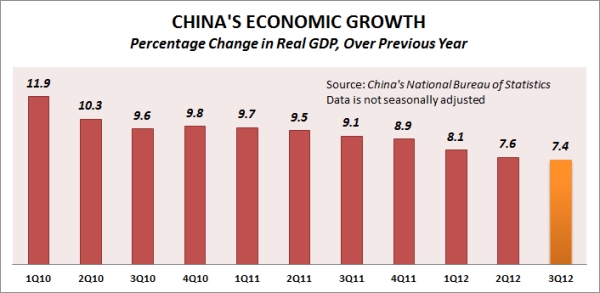
The data, in line with a Reuters poll forecast, missed the government’s target of 7.5 percent for the full year.
Other data released yesterday show industrial production expanded 9.2 percent, topping market expectations of 9.0 percent, and retail sales in September advanced 14.2 percent over September 2011, a full percentage point higher than the expectation for 13.2 percent growth.
Automated Port Terminals Slow to Catch On
Bill Mongelluzzo, Associate Editor | Oct 17, 2012 5:33PM EDT
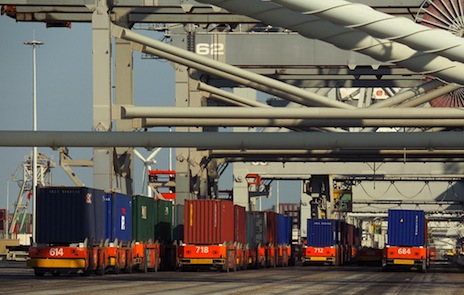
When Europe Container Terminals opened the world’s first automated terminal in Rotterdam 22 years ago, the maritime industry felt it was just a matter of time before automated container terminals were common around the world.
Little did it realize the concept would take so long to catch on. Today, there are 33 automated container terminals, and another 10 under construction, Olli Isotalo, president of the terminals division of Helsinki, Finland-based Cargotec, told this month’s Navis World conference in San Francisco.
Some of the features at ECT’s Rotterdam terminal, including automated container stacking cranes and automated guided vehicles to move containers from the vessel crane to the stacks are standard now. In fact, most automation “is no longer a challenge, according to Larry Nye, director of port planning and analysis at engineering firm Moffatt & Nichol.
Marine terminal architects and engineers, however, concede that building the right terminal with all of the features needed to drive down cost while increasing productivity and reliability — and fitting it all into the operator’s business plan — is a challenge.
That’s because each terminal operator faces unique requirements based on its annual container volume, the configuration of the facility at its disposal, the port’s mix of imports, exports and transshipped cargo, labor costs and a variety of other needs that can vary from terminal to terminal within the same port complex.
“The only standard for terminals is the container,” said Michael Richter, a senior port consultant for Moffatt & Nichol.
The time between advances in terminal automation is becoming compressed. ECT Rotterdam pioneered the use of driverless automated guided platforms to move containers from the quay crane to the container stack. ECT also introduced the use of an automated stacking crane to move containers from the waterside end of the stacks to a place of rest within the stacks.
This technology, though hugely expensive, slashes labor costs in high-volume facilities. AGVs at automated facilities have replaced the traditional yard tractors driven by longshoremen, and automated stacking cranes have replaced the rubber-tire gantry cranes driven by highly paid, skilled longshoremen.
Given the large cost of the machines, and the relatively primitive development of computerized terminal operating systems in the early 1990s, ECT Rotterdam was marked by low density and low productivity compared to today’s automated terminals, said Mark Sisson, senior port planner at Oakland, Calif.-based engineering firm AECOM.
The next level of innovation came in 2002 at the CTA Hamburg terminal in Germany. The automated guided vehicle in Rotterdam that followed a rigid path under the legs of the quay crane was replaced by free roaming AGVs operating in the backstretch of the shoreside crane.
Dockworkers responsible for the manual task of removing connecting cones from the containers were moved to a safe place on a platform at the crane. Rather than using straddle carriers to transport containers from the stacks to the gate, street trucks in Hamburg backed into the landside of the container stacks, eliminating the straddle carriers that cost $1 million each, Sisson said.
Both innovations reduced costs, and especially cost effective are the mobile AGVs that “run like a car,” Richter added.
The next improvements came only five years later at APM Terminals’ Portsmouth, Va., facility. The terminal, which introduced automation to the U.S., widened the automated stacking cranes to cover eight rows, and its quay cranes bumped productivity to 40 moves per crane per hour, allowing for a denser operation, Sisson said.
APM, however, chose to stick with traditional yard tractors, each driven by a longshoreman, so the Portsmouth facility is considered a semi-automated terminal.
The next development came a few years later when Euromax Rotterdam introduced semi-automated dual-hoist ship-to-shore cranes that lift two containers at a time.
While equipment manufacturers were developing automated cargo-handling machines, software manufacturers were developing the computerized systems to make the machines smarter and to integrate their operations so the entire terminal operates like an orchestra rather than a collection of different tasks throughout the facility. “Computer systems made it possible to automate the terminals,” Richter said.
Software today can manage every operation within the terminal, including vessel activities, transportation of containers within the yard and movement of containers to the gate and on-dock rail facility. The reach of the computer systems has been extended to coordinate the hand-off of containers at the gate and beyond the terminal to inland transport.
The systems are becoming so sophisticated, in fact, that in a truly automated terminal, managing the movement of containers and container-handling equipment is best handled not by a marine clerk looking out on the terminal from the tower, but with the clerk managing everything in front of a computer. “The only window into the system is the computer screen,” Richter said.
Despite these developments, there is still plenty of room for growth, and there is still a healthy debate over which technologies work best and under which conditions. For example, there are two schools of thought regarding the movement of containers from the quay crane to the stacks, Sisson said. Some operators prefer the automated guided vehicle with its basic platform design.
The AGV, however, must be positioned under the crane as the container is being lowered, requiring sophisticated software and coordination of crane and AGV activity. An alternative, the automated shuttle, can arrive at the crane after the container has been placed on the ground. The shuttle carrier then picks up the container and moves it to the stacks.
Industry experts also are looking for opportunities to add density to terminals to make better use of scarce waterfront land. At U.S. West Coast ports, where 50 percent or more of inbound containers move inland on rail, an important development will be to automate the movement of containers from the quay crane to the on-dock railyard.
The TraPac terminal in Los Angeles will automate its rail operation, but almost by default. The facility is oddly shaped — like a triangle rather than the traditional rectangle — for an automated terminal. But with the railyard positioned at the tip of the triangle, away from the street trucks that enter the main gates, TraPac will be able to move intermodal shipping containers from the quay crane to the railyard using automated shuttle carriers. TraPac, Sisson said, was able to turn a structural disadvantage into an asset.
The debate continues regarding the container volume required to justify the cost of an automated facility. At a busy European or U.S. West Coast port, where terminals handle 1 million 20-foot equivalents or more a year, a fully automated terminal makes sense.
When container volumes range between 500,000 TEUs and 1 million TEUs a year, a semi-automated terminal such as the Portsmouth facility in Virginia may make more sense. At terminals with an annual throughput of less than 500,000 TEUs, automation may be introduced to address a particular bottleneck in the yard or at the gate.
The key to deciding the right type and level of automation for a particular terminal starts with a business case, Nye said. The operator must have a clear plan to quantify its goals for capacity, productivity and operational costs. It then can design the right amount of automation into the facility to reach those goals without going over budget.