ETC International Freight System (www.etcinternational.com)
We are currently handling another shipment for Dalia at Carrington Group. Here’s her website:
Dalia imports evening gowns from China. Several “B” (or C) list celebrities have worn her dresses at awards ceremonies, but she no longer promotes that and appears to be leaning more toward weddings, school proms and the like. Beautiful imported garments & good fellows to work with.
Also, UDI' s Bakery Equipment (oversized) that originated from Germany using ETC International Freight System freight network, clearance, off-loading, warehousing and trucking the equipment on a flat bed out of State.
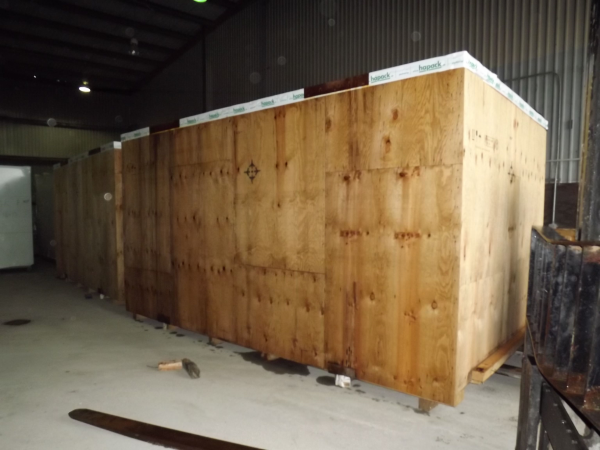
Above are pictures of the crates after they were removed from the 2 x 20' flatracks at Houston port and placed into inside storage at a Houston area warehouse. Udi's is under construction, and will not be ready for delivery of these units for about 2 months, and thus requested for ETC International Freight System to arrange the short term storage. Once they are ready, these will move on 40' flatbed trucks up to Louisville, CO.
NAFTA
Content mostly provided by JOC
20 years since the NAFTA agreement was enacted. What can be said 20 years later?
On the upside the North American — and global — supply chains are implemented and will continue to evolve. NAFTA is responsible for Canada, Mexico and the U.S. to become a “North American factory,” In the trade community many argue that the governments can’t rest on
their laurels. Supply chains crossing the trade partners are becoming more intertwined, with 40 percent of what the U.S. imports from Mexico American in origin. That means the clearance of cargo at the ports of entry needs to be faster and more reliable.
“After 20 years of success, it’s time to move the North American partnership up to the next level,” Thomas J. Donohue, president and CEO of the U.S. Chamber of Commerce, said in a speech this month.
NAFTA will leverage what Donohue called the energy revolution, the boom in North American oil and gas production. The availability of cheaper energy is expected to encourage more direct investment in NAFTA countries by overseas manufacturers.
Manufacturers and traders alike will need to build relationships with forwarders & customhouse brokers to insure the flow of shipments crossing borders. ETC International Freight System will provide you with the freight network & customhouse brokerage services to ease into your NAFTA experiences.
China weighs in
For NAFTA partners, the main manufacturing competition is still China, even if Mexico’s lower wages and proximity to the U.S. market has lured some manufacturing back across the Pacific Ocean.
NAFTA didn’t just eliminate tariffs between the U.S. and its North American partners. For manufacturers, transportation companies and logistics service providers, NAFTA had a much more positive and comprehensive impact than almost anyone could have imagined, often working to the detriment of competitors from China, which evolved rapidly into the world’s second-largest economy during the interim.
Numbers
NAFTA’s impact is undeniable: Total U.S. trade with Mexico was on pace to exceed $600 billion for the first time on an annual basis in 2013, up more than fivefold from a mere $81 billion in 1993, the last full year before the pact took effect. U.S. imports and exports with Canada have increased a more moderate three times, from approximately $210 billion in 1993 to some $630 billion in 2013.
Automobiles
“NAFTA has driven down our costs, and U.S. companies are building more global vehicles,” Robinet said. The trade pact made it possible for North America as a whole to become a global force in automotive trade. Because of NAFTA’s trade preferences, automotive companies in the U.S., Canada and Mexico “can use an engine from Mexico and a transmission from Canada, and then build the car in the U.S.,” and still enjoy the NAFTA preferential treatment, so long as 62.5
percent of the value of that vehicle comes from within those three countries. Today, the “vast majority” of vehicles built in North America have at least 75 percent combined value-added from those three countries, while some have well over 90 percent of North American value-added.
In 2013, Mexico’s vehicle production exceeded 2.9 million units. By 2020, almost 25 percent of all North American vehicle production will be in Mexico, compared with only 10 percent in Canada and 65 percent in the U.S. “This is a flip-flop of the positions of Mexico and Canada,” Robinet said. Eduardo Solis, president of the Mexican Auto Industry Association, said Mexican auto output is expected to reach 4 million cars and light trucks a year by 2017.
The success of auto manufacturing, along with aerospace production, helped encourage white goods and electronics manufacturers to set up shop south of the border. Foxconn, the electronics maker best known for its Chinese plants, produces Dell computers at its San Jeronimo plant, allowing Americans to get a laptop in their hands within a week of online purchase.
Appliance manufacturers such as Whirlpool and Electrolux produce mostly for the U.S., but
emerging middles classes in Mexico and Central America position shippers for even larger growth. Mexico’s title as the holder of the most free trade agreements — 44 — set it up to become a regional manufacturing powerhouse.
Mento said his customers are seeing “more opportunities to service retail in Mexico with their goods.” C.H. Robinson’s greatest volumes have been in “heavy, big” goods in construction, oil and gas, chemicals and hazardous materials. As Mexico’s industrial sector becomes more sophisticated, however, the “biggest shift has been toward more complex and technically astute goods.” Moving northward into the U.S., C.H. Robinson is handling “massive” imports of food
and beverages from Mexico.
Building a North-South Rail Network
NAFTA’s progress also has been a boon to Kansas City Southern Railway, which already has access to numerous auto plants in Mexico. KCS’s cross-border intermodal volume will continue to expand not just because of Mexican manufacturing growth, but because of the strong advantage rail has over the trucking industry south of the border, said Patrick Ottensmeyer, chief marketing officer at KCS. In addition to better security, rail shippers can save $100 to $250 on the shuttle driver that moves freight between Mexican and American truck drivers by
switching to intermodal. Getting through ports of entry security adds at least another two hours to cross-border truck moves, whereas the customs process for a train hauling 240 containers takes about 30 minutes. The network of the smallest Class I railroad in North America connects to the other six Class I carriers, allowing shippers to access sunny Mexican factories from frigid
Canada.
The railroad has seen high double-digit quarterly intermodal growth, as makers of automotive, white goods and other products have shifted production to Mexico. The production boom and the $375 million that KCS has invested in its cross-border network helped drive its intermodal growth up 27.5 percent year-over-year in the second quarter of 2013. The phase-out of a national fuel subsidy will continue to hurt the Mexican trucking industry, particularly as few companies charge a fuel surcharge, Ottensmeyer added. Mexican diesel prices are now close to those in the U.S., and represent about 33 percent of the total transportation cost, he said.
The rising fuel costs are hurting the fragmented Mexican trucking industry as carriers struggle to replace their fleets, the average age of which is now 17 years. Motor carriers face poor access to credit, and most provide little training to drivers.
Danger Signs
Overall, Kemmsies believes “NAFTA is on the cusp of being a great success,” but he’s “afraid that Mexico will kill the golden goose before it lays an egg” by imposing export taxes on foreign companies doing business there before those companies are fully convinced they should be in Mexico for the long haul. “Mexico has to worry about overplaying its hand” before the global automakers and other foreign investors have sunk their roots more firmly into Mexican soil.
For example, he noted, every Toyota Tundra assembled in Baja California must be trucked to Long Beach because there is no Mexican rail service to that port. As a result, it would take much less time for some companies in Baja California to uproot from Mexico and move elsewhere, in the event the Mexican government imposes overly burdensome taxes.
The Mexican government’s recently approved $14 billion tax plan also will blunt the competitive edge of Mexican manufacturers. Starting in 2015, Maquiladoras will have to pay a valued-added tax of 16 percent and their income taxes will rise from 17.5 percent to 30 percent this year. The potential silver lining is that the tax overhaul could encourage maquiladoras to mature their supply chains, as companies that only add minimal value to products before exporting them would see less advantages of doing so.
Given the fragile state of the global economy, many companies “are still scared and risk-averse,” Kemmsies said. “The time to raise (tax) rates is not today. We are not past the start-up stage in Mexico.”
War on Drugs
The threat of drug cartel violence continues to impede Mexico’s economic growth. The headlines blaring news of grisly mass graves have become less frequent since President Pena Nieto took office in December 2012. But kidnappings have risen even if homicide rates have fallen, according to the James A Baker III Institute for Public Policy, a nonpartisan think tank.
The Mexican military’s decision in November to take over the Port of Lazaro Cardenas to crack down on surrounding drug war activity and the import of precursor chemicals used to make methamphetamine shows that crime and freight movement remain entangled.
The drug violence has only exacerbated the U.S. government’s decision to often focus on security at the expense of the movement of goods and people following the September 11 terrorist attacks. The two missions don’t have to be mutually exclusive, said Christopher Wilson, an associate at the Woodrow Wilson Center’s Mexico Institute. Customs and Border Protection’s plan to create a pilot allowing some shippers to fund additional border crossing staffing during busy times or for extended hours is encouraging, he said. The agency also is launching three pilot programs aimed at speeding goods across the border through pre-inspection.
Customs’ Challenge
A proposed House-Senate spending deal would fund the hiring of 2,000 more U.S. Customs agents in fiscal 2014, but it’s not clear where the new personnel would be deployed if Congress gets on board. The targeted force of 23,775 CBP officers would be the largest in history for
Customs. The busy border crossing between San Diego, Calif., and Tijuana, Mexico, also would get $128 million for modernization if the spending deal is passed.
Still, with a tight federal fiscal climate, shippers likely will have to take on more of the customs costs if they want big improvements in service, but cost-sharing arrangements can’t go beyond the pilot level without congressional approval.
In the meantime, Customs needs to establish service standards for the clearance of goods at ports of entry and create an appointment schedule to make better use of staffing, said Leslie Blakey, executive director of the Coalition for America’s Gateways and Trade Corridors. Customs needs to better promote its trusted trader programs, as the ranks of the Customs-Trade Partnership Against Terrorism and Free and Secure Trade Program have been nearly static, Wilson said.
The 1,000-plus Mexican manufacturers and roughly 900 Mexican carriers certified under C-TPAT are less likely to be inspected by U.S. Customs, allowing agents to focus their scrutiny on higher-risk cargo movements. The agency also is working with its Mexican counterpart, the Tax Administrative Service, to gain mutual recognition of their respective trusted trader programs,
Ultimately, further NAFTA integration will require more trust among trade partners. The U.S., for example, will have to come to grips with Customs agents not being able to carry guns anywhere they like when they pre-inspect goods in Mexico.
The requirement complicates Customs’ attempt to launch a pilot allowing goods to be pre-screened at Foxconn’s facility before heading over the border to Santa Teresa, N.M. Mexican customs officials store their guns in lockers after their shifts pre-inspecting goods at Laredo International Airport ends, Wilson noted.
“In the long term, we need a single port of entry where customs (agencies) are integrated and both countries work side-by-side and share information, not on weekly basis, but on a second-by-second basis,” Wilson said. “This is where we should be headed, and the pre-clearance programs are starting to take us there.”
Our shippers freighting through the NAFTA review with ETC International Freight System (Sales@etcinternational.com) their shipping scenarios to maximize efficiency.